
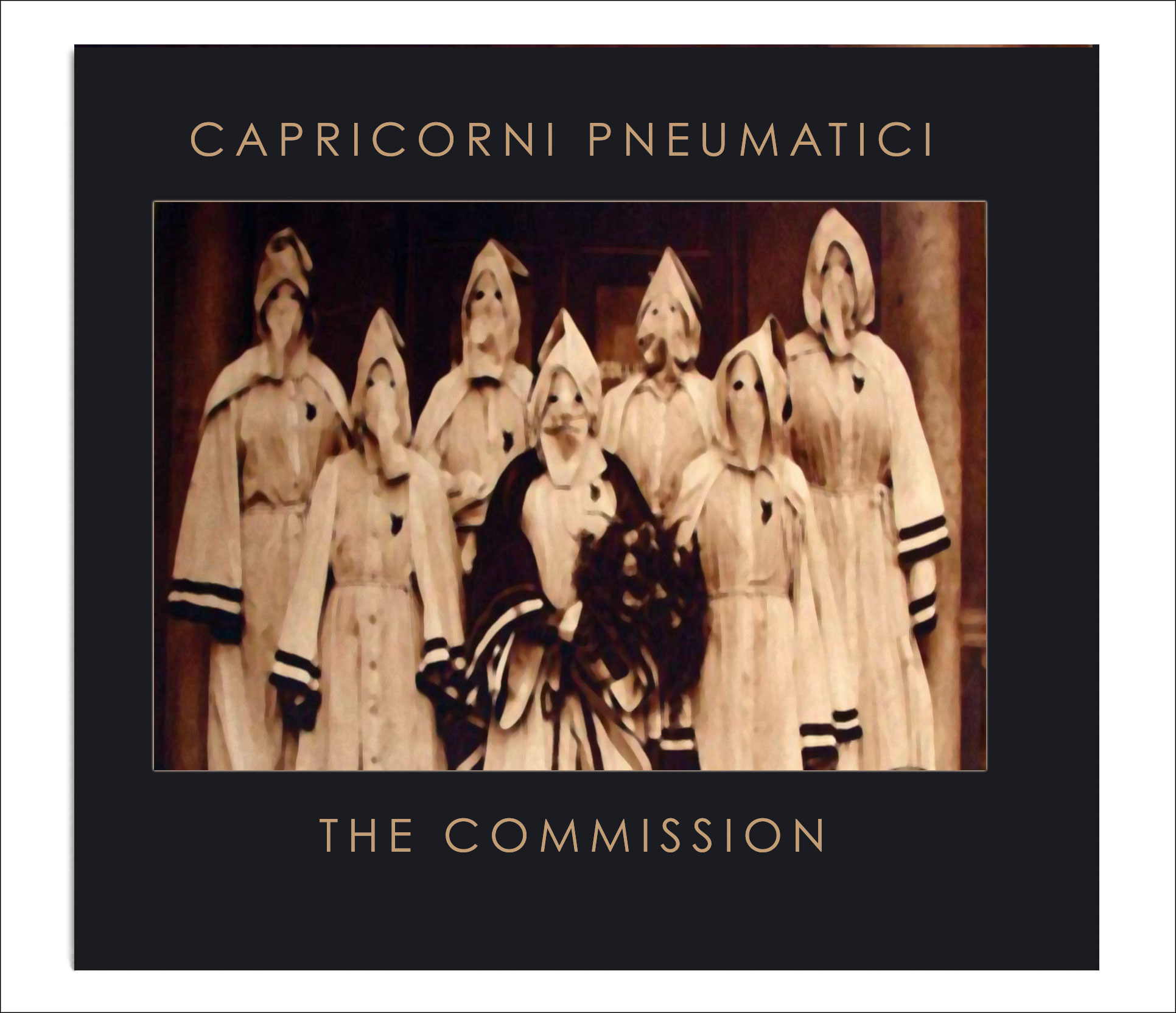
Forty years after the original June 1986 session, Capricorni Pneumatici return with The Commission, a work that does not merely place past and present in relation but forces them to coexist within a single sonic and symbolic field.
The record moves along a line that is not narrative but stratified: archival material, subsequent reworkings, and new compositions intertwine without any evident hierarchy, as if they belonged to different states of the same sonic matter. In this sense, the work does not “tell” time; it renders time unstable. A quality runs through the entire project and points directly back to the historical dimension of Capricorni Pneumatici: the construction of sound as a physical, almost ritual phenomenon, achieved through unconventional devices and recording conditions that privilege the material presence of sound over its aesthetic form. In The Commission, this approach takes on a more ambiguous and stratified valence. The 1986 recordings are not treated as archive but as active residues, still capable of generating interference in the present. The new elaborations seek not to clarify or order but to reopen a space in which materials contaminate one another. The two central tracks, tied to the pandemic period, introduce a more closed and suspended dimension, where the idea of isolation seems to translate into a perceptual density that is not descriptive but atmospheric. It is here that the record assumes a more explicitly dark shading: not as aesthetic, but as condition, as prolonged suspension between states.
Taken as a whole, The Commission functions as an apparatus for temporal reactivation. There is no true point of origin and no clean conclusion: what emerges is a system in which different materials seem to belong to a single subterranean continuity, as if the work had always existed in a latent form. This coherence with the trajectory of Capricorni Pneumatici is evident: from their earliest outings, the project has operated at the margins of traditional musical definition, moving instead toward a practice of sonic exploration in which matter, space, and the perceptual dimension become central elements.
The Commission situates itself precisely within this trajectory, accentuating its more enigmatic and stratified component. It is not a record that allows itself to be decoded linearly, but a work that insists on an unstable perceptual threshold, where sound seems to function as the trace of something that precedes and exceeds listening itself.
Caesar